20
THE IMPACT OF CATTLE GRAZING ON A RECENTLY
REHABILITATED GRASSLAND ECOSYSTEM IN AN
OPEN CAST COAL MINE IN MPUMALANGA
N. D. THOVHAKALE & E. M. STAM
Introduction
Coal mining companies make considerable efforts to
rehabilitate the landscape after open cast mining, recreating
natural contours, returning the top soil, sowing grasses and
controlling erosion. While the ultimate aim of these efforts is
to return the land to a state where it can be used again, either
for agriculture or grazing, the decision as to whether the land
has reached that point is not easy to make. On the one hand
the mine cannot afford to keep managing the area for too long,
on the other hand it may take time for the area to be stabilised
sufficiently for a handover.
After rehabilitation, vegetation succession commences and
this is a process that takes place on a timescale of decades, if
not centuries and influenced by regular veld fires and grazing.
Natural grazing has an important function in grassland
ecosystems in that it stimulates growth, prevents the formation
of moribund material and promotes species diversity.
However, grazing intensity in most natural systems is generally
much lower than in meadows grazed by cattle. In the latter
there is always the danger of overgrazing leading to veld
degradation and erosion. It is likely that a newly rehabilitated
area in an early stage of succession is extra vulnerable to
overgrazing.
The impact of cattle on rehabilitated land is not necessarily only
negative. For instance, their hoovesmaybreak the impenetrable
soil crust which is found in many rehabilitated areas, thereby
allowing water to penetrate the soil. The trampling of old plant
material into the soil as well as manure may enrich the soil with
organic matter, and if the cattle are moved in from elsewhere
they may also bring seeds of species that are not yet present
on site.
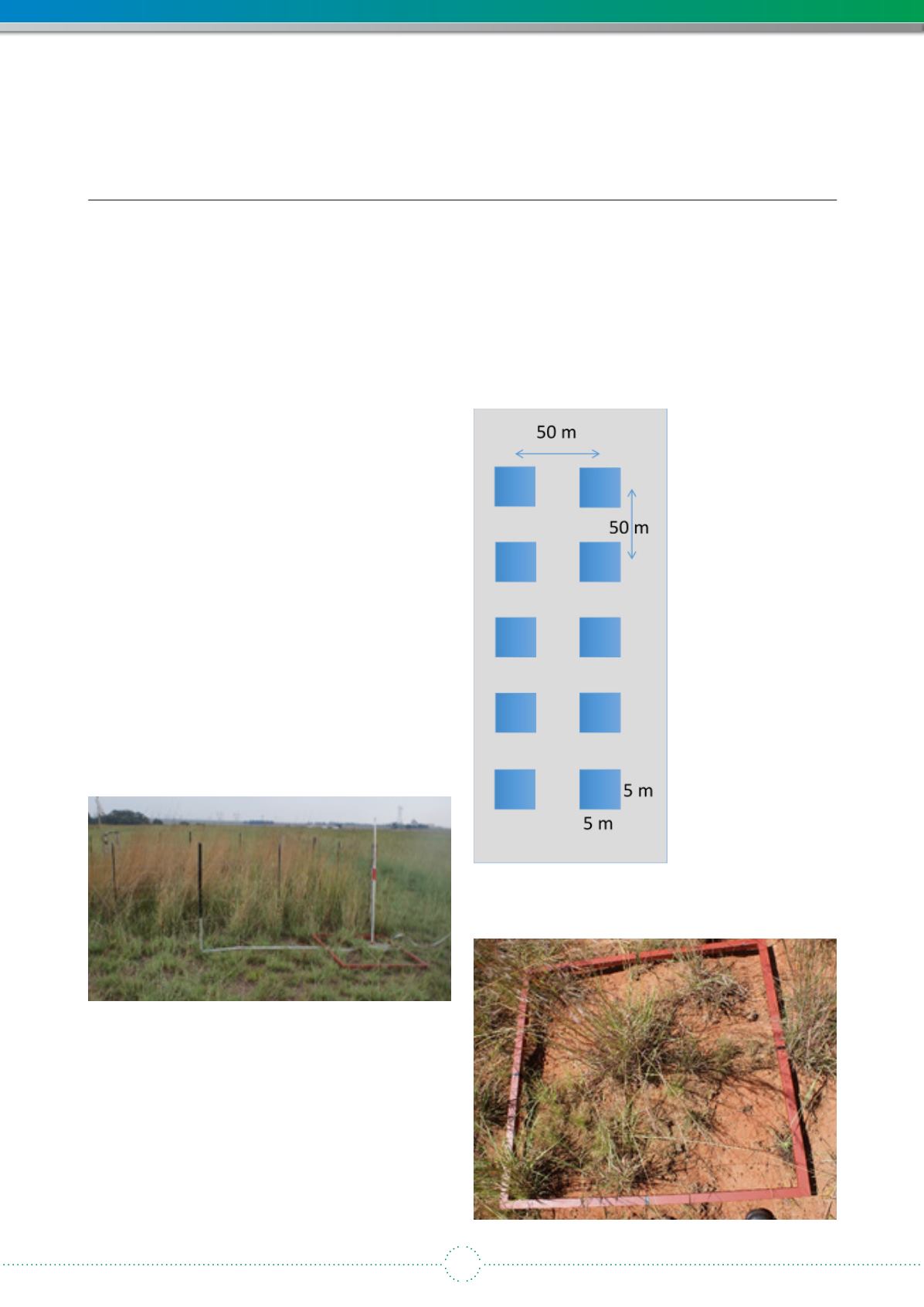
Figure 1 Enclosure
The question whether cattle have a positive or negative impact
on rehabilitated grassland is being tested on a site near Ogies,
in the Mpumalanga Province, using ten 5 x 5m exclosures
(Figure 1). The function of the exclosures is to prevent grazing
in the enclosed area. With time it becomes possible to assess
the effect of grazing by comparing the vegetation inside
and outside the exclosures. The site where the exclosures are
constructed is 31.8ha in size. The exclosures are arranged in
two parallel transects, 50m from each other (Figure 2).
Two vegetation surveys were carried out, the first in
March 2017 and the second in February 2018. During these
surveys three samples were taken inside and outside of a one
square meter quadrat, resulting in a total of 60 samples. A disk
pasture meter was used to derive estimates of the biomass
and two soil samples per exclosure were taken. Finally two
benchmark sites in the vicinity of the experimental site were
identified.
Bare Ground
Figure 2 Layout of the experiment. The exclosures are not
drawn to scale


