28
Coal with considerable amounts of intrinsic ash forming
minerals, which cannot be liberated by means of crushing,
prove extremely difficult to beneficiate. Conclusively, it was
established that the quality of the coal in terms of amount
of inorganic matter (minerals) present and the measure to
which these are intimately mixed with the organic matter
(microlythotypes), significantly influenced bed segregation.
From this it can be noted that a blended feed coal, containing
a variety of qualities, is best suited for the dry beneficiation of
coal in ADMFB and that extensive optimisation of the operation
in all aspects is crucial. Furthermore continuous operation of
the bed is required to ensure that the drawbacks of a batch-
type experimental run, most especially with regard to vibrated
dense medium beds, are negated.
University of Pretoria: Drymedium recovery with the use of
magnetic separation
The first draft of the completed dissertation by Jumandie
Pieterse was on 1 July 2018.
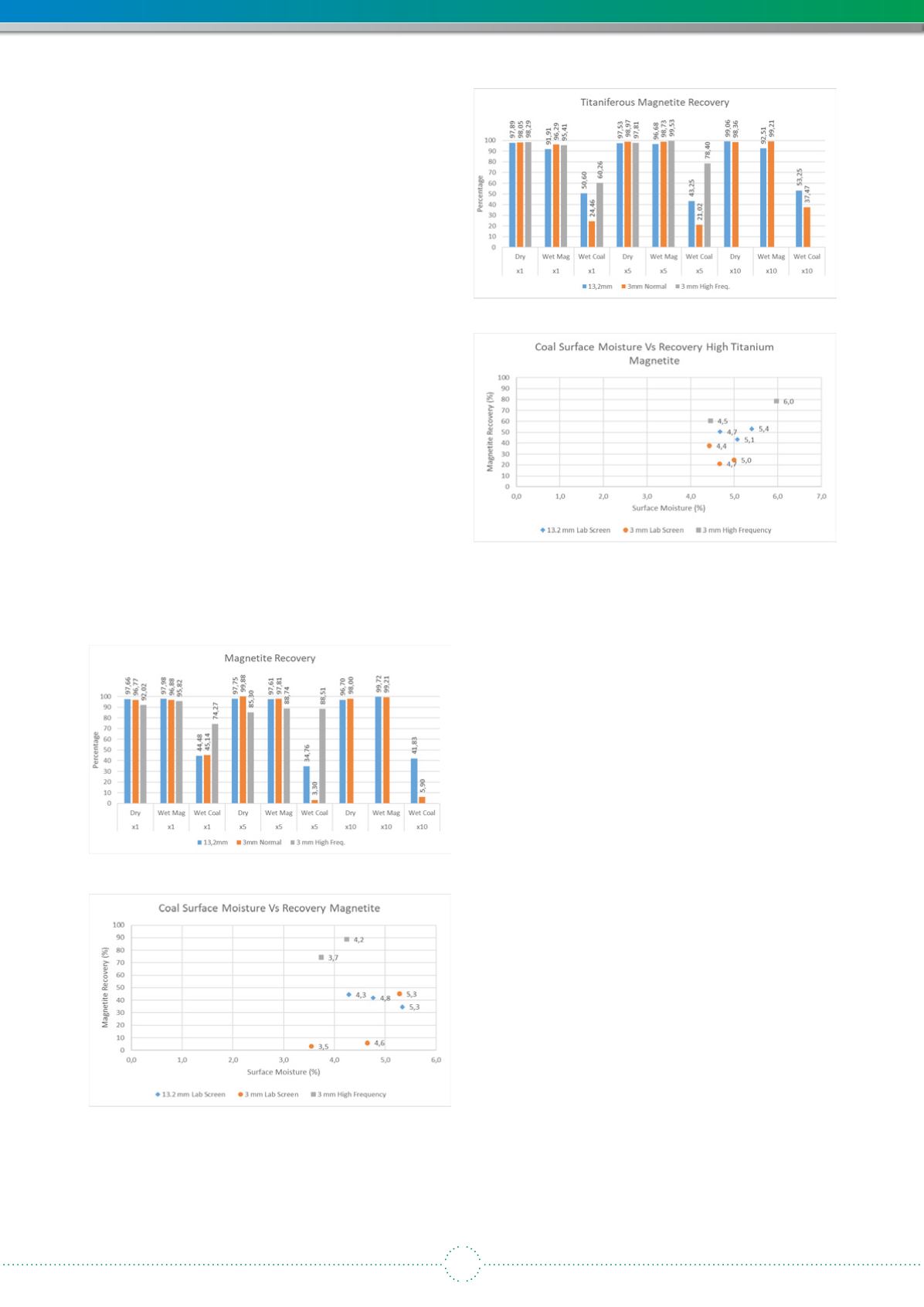
The highest magnetite recoveries, as shown in Figure 2 and
Figure 3, were obtained from using dry samples (dry coal and
magnetite). It is clear that themoisture content of themagnetite
has no effect on the recovery of the magnetite. Furthermore
the results indicate that there is a huge drop (>50%) in recovery
when wet coal (>4 to 5.5% surface moisture) is introduced in
the processing, and this only occurred when the magnetite was
used once. The magnetite recovery dropped even further when
the magnetite was re-used for five and 10 repetitions. The use
of a high frequency screen, as the first step in the recovery of
the magnetite, seems to improve the recovery of the magnetite
for the wet coal. Therefore, it is important that high frequency
screening forms part of the dry dense medium separation
process.
Figure 2: Magnetite recovery
Figure 3: Coal surface moisture vs magnetite recovery
The results obtained for the Titaniferous Magnetite (Figure
4 and Figure 5) showed similar trends. The recovery of the
titaniferous magnetite was overall better for the wet coal than
that of the magnetite. The high frequency screen also delivered
improved recoveries.
Figure 4: Titaniferous Magnetite Recovery
Figure 5: Coal SurfaceMoisture vs HighTitaniumMagnetite
Recovery
Therefore it can be concluded that an increase in the surface
moisture of the coal has a negative effect on the recovery of the
magnetite and titaniferous magnetite. The results confirmed
that it is essential to dry the coal before entering the Bohou
process. The coal product and waste obtained from the Bohou
process should also be screened with high frequency screens
to achieve optimum medium recovery.
University of Pretoria: Recovery of Ilmenite (medium) from
a dry dense medium fluidised bed
In this study, by Kalenda Narcisse (recently completed and
in the examination process), Ilmenite is considered as an
alternative medium to the magnetite currently used, due to
its clean surface properties, hydrophobicity, and sphericity.
It is expected that the ilmenite will not attract contaminants to
its surface and will not be lost to the coal due to attachment.
The research has proven that there are ilmenite resources
available in South Africa, especially in the deposits located
along the eastern, southern and northeastern coasts. Ilmenite
is found in heavy mineral sands which contains typically
90% ilmenite, 5% Ti-hematite, 3% spinel (including chromite
and magnetite) and 2% silicates by weight. Ilmenite minerals
are recovered in three significant mines namely, Namakwa
Sands Mines (Tronox), Richard’s Bay Minerals (Rio Tonto) and
KwaZulu-Natal (KZN) Sands (Tronox). Kenmare Resources
(Moma) is also a potential producer of ilmenite in Mozambique.
Based on USGS reported data of the world production of
ilmenite in 2017, South Africa produced an average of 1 300
thousand metric tons of ilmenite.
Figure 6 shows the results of the ilmenite recovery for the
various conditions. It is important to note that the results
depictedwere only screenedwith the use of a laboratory screen
(no high frequency screen was used). The results showed the
dry coal and wet ilmenite 2% had the highest recovery of
ilmenite, with the lowest recovery observed in the wet coal
4.4% and dry ilmenite respectively.


