27
Another major outcome of this study was to design an enlarged
ADMFB for processing of large particle sizes and increased bed
loads. This was approached by an initial fundamental process
design in which the modified Ergun and associated fluidisation
equations were used to obtain the minimum fluidisation
velocities and corresponding bed pressure drop and height for
each variable considered. From these results, the bed geometry
and dimensions of the new assembly were designed, showed
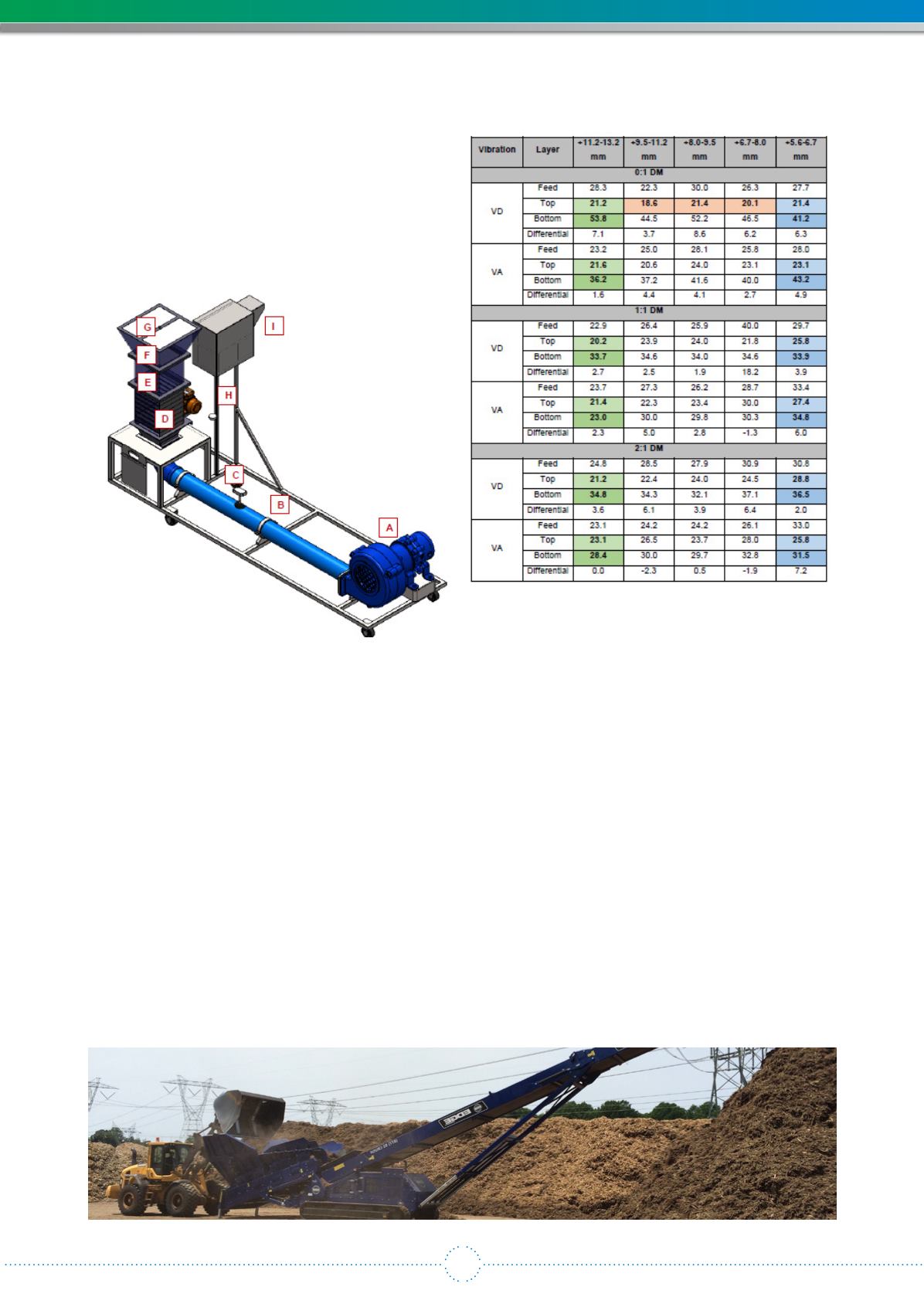
in Figure 1. A 0.3m by 0.3m square bed structure was selected,
made up of eight 0.05m transparent PVC layers that fit perfectly
into another to prevent air and material leakages.
Figure1: DesignedfluidisationsetupshowingA) theblower,
B) circular air duct, C) air flow transmitter, D) distribution
plate, E) fluidised bed layers, F) fluidised bed extension, G)
tapered head, H) vibrating motor and I) control box
This makes up the fluidising layer of the bed, which is mounted
on an air distributer mechanism that is affixed to a centrifugal
fan delivering an even distribution of air at the required velocity.
The effect of vibration is of interest to this study and bed
vibration, when required, is induced by means of an oscillating
vibratory motor with adjustable frequency and amplitude.
Accurate flow and pressure readings, required for establishing
a stable fluidised bed, were attained from an air velocity sensor
and water based manometer, respectively.
Dry beneficiation of the coal was attained within ADMFB, in
varying degree, for each of the variables listed above. For a
theoretical product of 75% bed volume (or the top three bed
layers), ash yields obtainable are recorded to vary between
13 and 17.6% with a corresponding mass yield percentage
range of 27.6-34.2. For the experiments conducted in this study,
these values worsen slightly when considering the addition of
dense medium and vibration. These results are summarised in
Table 1.
Table 1: Summary of results for -13.2mm +5.6mm particles
in an ADMFB using magnetite as medium
When focusing on the ash values in the feed, top and bottom
layers of the bed, a decrease in coal particle size distribution
(PSD) proves to have an effect on the extent of separation in
the bed. All considered PSD ranges yielded comparable ash
values in the top, intermediate and bottom bed layers, but
the larger PSD (+11.2-13.2mm) yielded the best performance
curves when considering ash value and mass yield. Ash content
values ranging from 18-30%wt were obtained in the top bed
layers over all variables considered, depending on the ash
content of the feed and whether dense medium or vibration
are present during operation. It was further established that
the addition of dense medium (magnetite) did not have a
remarkable effect on the separation efficiency of ADMFB. The
experimental runs conducted with dense medium yielded less
desired results in the top, intermediate and bottom layers of
the bed when compared to those of only coal. The activation of
vibration too, showed no improvement to the extent to which
ADMFB separates the coal, middling and gangue products.
However, noticeable was that a decrease in PSD, addition of
dense medium and activation of vibration had a significant
impact on the operability of ADMFB in terms of minimum
fluidisation requirements and bed stability.


