18
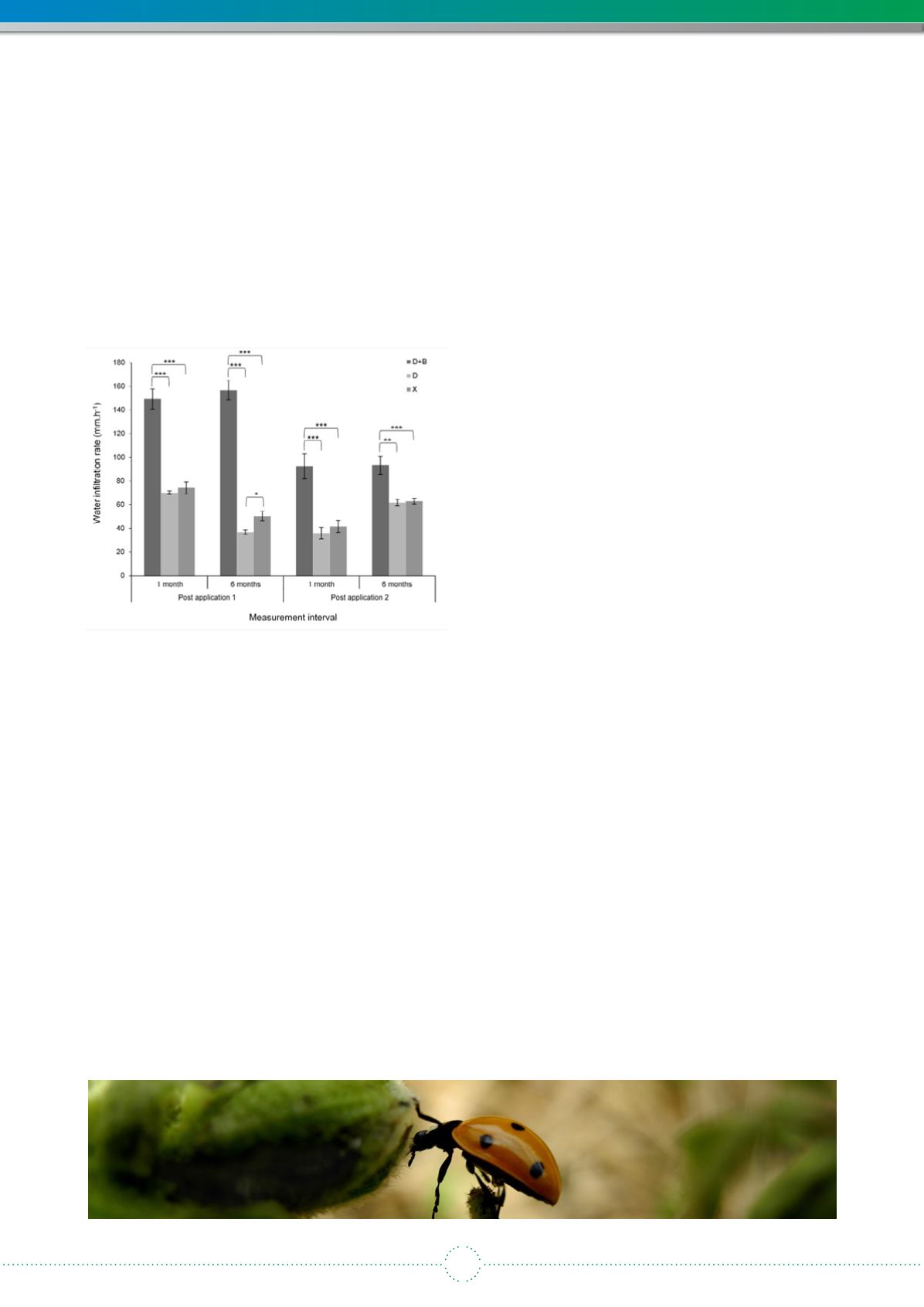
4. Dung beetles improve water infiltration rates
Water infiltration rates are significantly higher on dung
beetle treated experimental plots. Improvements ranged
between a 30% and 300% increase in the volume of water
infiltrating the soil. The latter increase resulted in a difference
of approximately 100mmh
-1
with dung beetles. In field trials,
the water infiltration rates improved significantly following
the application of dung beetles. Improvements are not as
drastic as in the experimental plots with a maximum of 35%.
The difference in results is likely a reflection of environmental
heterogeneity and larger spatial area covered in the field
trial. Nevertheless, this result is highly beneficial for plant
growth and results in less surface runoff, which reduces soil
loss (erosion) rates.
Graph showing how experimental plots where dung
beetles have been applied (dark grey bars) had
significantly higher water infiltration rates than
reference plots (medium and light grey bars). Water
infiltration measurements were taken one month and
six months after two dung and beetle applications
5. Dung beetles reduce soil compaction
On experimental plots with dung beetles, soil compaction
(penetration
resistance)
decreased
significantly.
The greatest increase was seen one month and six months
following the second dung beetle application. In the latter
measurement, penetration resistance reached a maximum
of 430kPa while the sites with no beetles had maximum
values greater than 1 100kPa. This is a reduction in soil
compaction of more than 150%, and suggests that repeated
applications of dung beetles could enhance certain benefits
associated with their tunnelling activity. The results of the
experimental trial have been reinforced in the field trial,
where reduction in soil compaction after all dung beetle
applications can be observed. However, the results are
not sustained in the long term. Measurements taken at
random points in the enclosures included areas where dung
beetles had tunnelled and where they had not. These results
emphasise that improvements are localised beneath dung
pats, and did not extend beyond this area.
6. Vegetation biomass is increased where dung beetles are
active
Post dung beetle applications on experimental plots,
vegetation biomass showed a general pattern of increase.
Improvements are significant six months post the first dung
beetle application, and one month after the second dung
beetle application, increasing biomass significantly between
100% and 60% respectively. In field trials, there has been a
large increase in biomass (± 50%) following the first dung
beetle application. Although biomass is generally higher on
thedungbeetle treatedplots in followupmeasurements, the
differences are not statistically significant. Although results
are not consistently significant in both the experimental and
field trials, there is a general trend of increased vegetation
biomass where dung and dung beetles were applied.
7. Dung burial leads to increased soil nutrients
At various stages of measurement post dung application
significant increases in phosphorus, potassium, calcium,
magnesium, and cation exchange capacity were measured
on experimental and field plots. In particular there were
increases in potassium and magnesium, and in the cation
exchange capacity. While none of these parameters are
maintained at elevated levels throughout the study, their
periodic increase in the dung beetle treated plots indicates a
degree of nutrient enrichment not present in the untreated
plots. Fluctuations in nutrients may depend on the nutrient
content of the dung buried and the vegetation growth
phase.
Do dung beetles provide a viable and practical solution?
1. The requirement for good quality dung
Dung beetles feed on, and breed in, dung. Without it they
will not be attracted to a site and cannot be sustained.
The dung source could be from cattle or game, from animals
on site, or it could be collected and spread by humans.
The latter is time intensive but could create jobs. However, it
is more practical to introduce livestock for grazing to attract
beetles. However, many endo-parasiticides used to treat
livestock contain toxic residues in the dung that are lethal to
beetles when ingested. Therefore, if livestock are introduced
with one of the aims being to attract dung beetles, then this
aspect would need to be carefully managed. This can be
achieved through the use of tested ‘Dung Beetle Friendly’
products and strategically planning treatments to coincide
with periods of lower dung beetle abundance.
2. How many beetles are needed to make a difference?
In this study, for most appplications, 20 beetles were used.
At this rate, ameasurable improvement in soil andvegetation
parameters is achieved. Most of the dung in a 1kg dung
pat is also buried, reducing effects of pasture fouling and
maximising the recycling of nutrients. However, the positive
effects of beetle activity are concentrated beneath the dung
and don’t extend horizontally beyond the dung pat to a
great degree. Unless every square inch of ground is covered
with dung and worked by beetles (which is impractical), the
effects will inevitably be heterogenous in space and time.


