12
Tabulated are the operating criteria of the Terrajets finalised
during the workshop trials. These values will be confirmed on
the CM when the installation and the surface trials at Komatsu
in Wadeville are completed.
The following criteria will determine the effectiveness of the
terrajet system when trialled underground:-
1. Minimising/eliminating methane trips
2. Eliminating the risk of a methane ignition/explosion
3. Less methane trips = Increased production
4. Possibly reduced airborne dust generation
(To be confirmed
through extensive dust measurements)
The assembly of the CM with the integrated scrubber is behind
schedule, but detailed methane and dust concentration results
will be presented to the industry at the end of August 2018.
PHASE 5 – OPTIMISE THE FACE VENTILATION SYSTEMS
The focus of the last phase, Phase 5, is to develop and propose
a face ventilation system that can optimally deal with excessive
dust and methane going forward, while considering the results
of the past five years and the results from the Terrajet trials.
The suggested criteria and primary considerations of an ideal
Face Ventilation System listed under Phase 5 include: .
y
y
Deliver high energy air directly and continuously into the
cutting zone.
y
y
Be practical and not require extensive maintenance.
y
y
Developed to such a degree that human intervention is
minimum.
y
y
Work in balance with the on-board systems currently in use.
y
y
Integrate into the operating systems of the CM.
y
y
Prevent the potential build-up of hybrid mixtures (dust and
methane) around and underneath the cutting drum.
y
y
Minimum water usage.
When the Terrajets are proven, under Phase 4, and accepted
by the mines as effective in the control of the hybrid mixture
inside the cutting zone, the above criteria should be part as
a standard requirement against which all face ventilation
systems are measured and evaluated.
Phase 5 will focus on three deliverables:
1. Optimise the design criteria for an effective face ventilation
system – Scrubbers, air-movers, fan volumes, duct distances,
etc.
(Using previous CFD results and new proposed CFD
models as guidance, proving the concept designs through
underground evaluations).
Also using the criteria for the ideal
Face Ventilation System as per above.
2. Consider practical and effective means to measure, monitor
and evaluate the effectiveness of the face ventilation
system. Use existing methods and protocols as a guide.
The positioning of real-time monitoring sensors/equipment
such as methane, dust and pressure sensors within the on-
board scrubber is to be investigated as a means to evaluate
the performance of the ventilation system on a continuous
real-time basis.
3. Develop virtual reality (VR) training videos on airborne dust
andmethane control using the ideal face ventilation system.
The design criteria for the Face Ventilation System will be
researchedusingprevious CFD results andpractical information
from the Coal Mining Ventilation fraternity. The results from
the Terrajet Trials will conclude the design proportions and it
is requested via the industry that a Face Ventilation Manual
be compiled to be used as a guide to effective and practical
ventilation practices.
One of the major concerns raised from ventilation practitioners
is the failure of on-board scrubbers without warning.
Scrubbers that do not ventilate a face area effectively, create
unhealthy and unsafe working conditions for the workers.
A possible solution is to have a continuous, real-time sensor
installed inside the scrubber that can monitor the performance
of the scrubber and report any failure or malfunction
instantaneously through visible or audible means.
A company Environmental Process Analytics, possibly has the
technology available to measure and monitor the differential
pressure across the airflow path of the scrubber. This includes
the performance of the scrubber fan and the status of the
scrubber screens that filters out the dust.
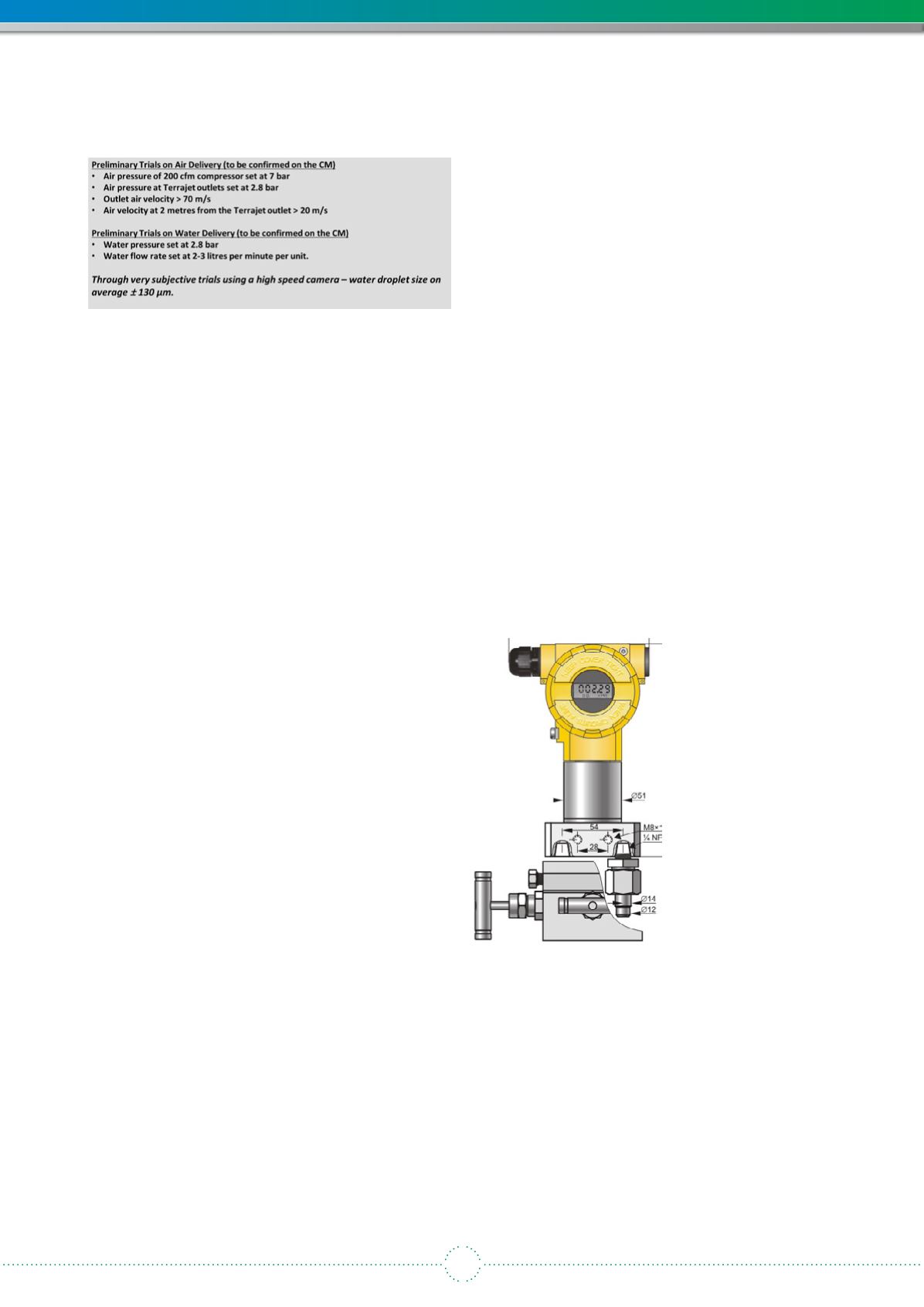
Shown below is a typical image of a sensor that will be used
for initial surface trials on a CM to determine the effectiveness
and accuracy of this technology. Should the initial trial results
be successful the unit will be installed on an underground
trial CM and the results monitored over a prolonged period
of time. Through the use of this technology the control and
responsibility is given back to the operator and section
management to ensure that the coal face is ventilated
effectively at all times.
Figure 5: Pressure sensor that can measure the differential
pressure inside a scrubber
CONCLUDING REMARKS
Due to several contributing factors, Phase 4 could not be
completed on time. After surface trials at Komatsu the
underground trials at Shondoni Mine outside Secunda will
follow. It is envisaged that initial set of underground results
will be available towards the end of July 2018 and the project
will be concluded at the end of August 2018, after which a full
report will be published.
Phase 5, the concluding Phase of the original Methane Project,
has commenced and will continue in the interim while Phase 4
is drawing to conclusion. The results from Phase 4 will be crucial
to be able to put forward some recommendations on effective
Face Ventilation.


