14
Beck Engineering has simulated the regional collapse of
bord and pillar workings in 2 Seam at a Witbank colliery.
The simulations aimed to:
1. Provide insight into the underlying rock mechanics of such
collapse events.
2. Quantify, as far as possible, the strength of the system of
coal pillars and the stored strain energy in the overburden
prior to the collapse case considered.
The Witbank coalfield in South Africa has been worked
extensively for decades with underground extraction focusing
on 5 Seam, 2 Seam and more recently, 4 Seam.
In many areas, 5 Seam and 2 Seam were mined with bord and
pillar methods before the advent of Salamon & Munro’s pillar
strength estimates introduced in 1960 in the wake of the
Coalbrook disaster.
According to the pillar strength estimates, many of the
pillars in 2 Seam have safety factors of less than one. This has
effectively sterilised many millions of tonnes of coal in 4 Seam.
However, many of the pillars in 2 Seam have not “failed”,
even though their safety factors are less than one according
to Salamon & Munro’s estimate. This suggests some level of
conservatism in Salamon & Munro’s strength estimates, and
represents a significant potential opportunity to recover parts
of 4 Seam that are currently sterilised.
The key question is: What is the real strength of the coal
pillars? Answering this question may allow the “unlocking”
considerable 4 Seam coal reserves in the Witbank coalfield.
This project aims to demonstrate that this key question can
be addressed by using finite element (FE) simulations to back-
analyse one regional collapse in 2 Seam and thereby infer
the real safety factor of the coal pillars and the role of the
overburden, as far as possible.
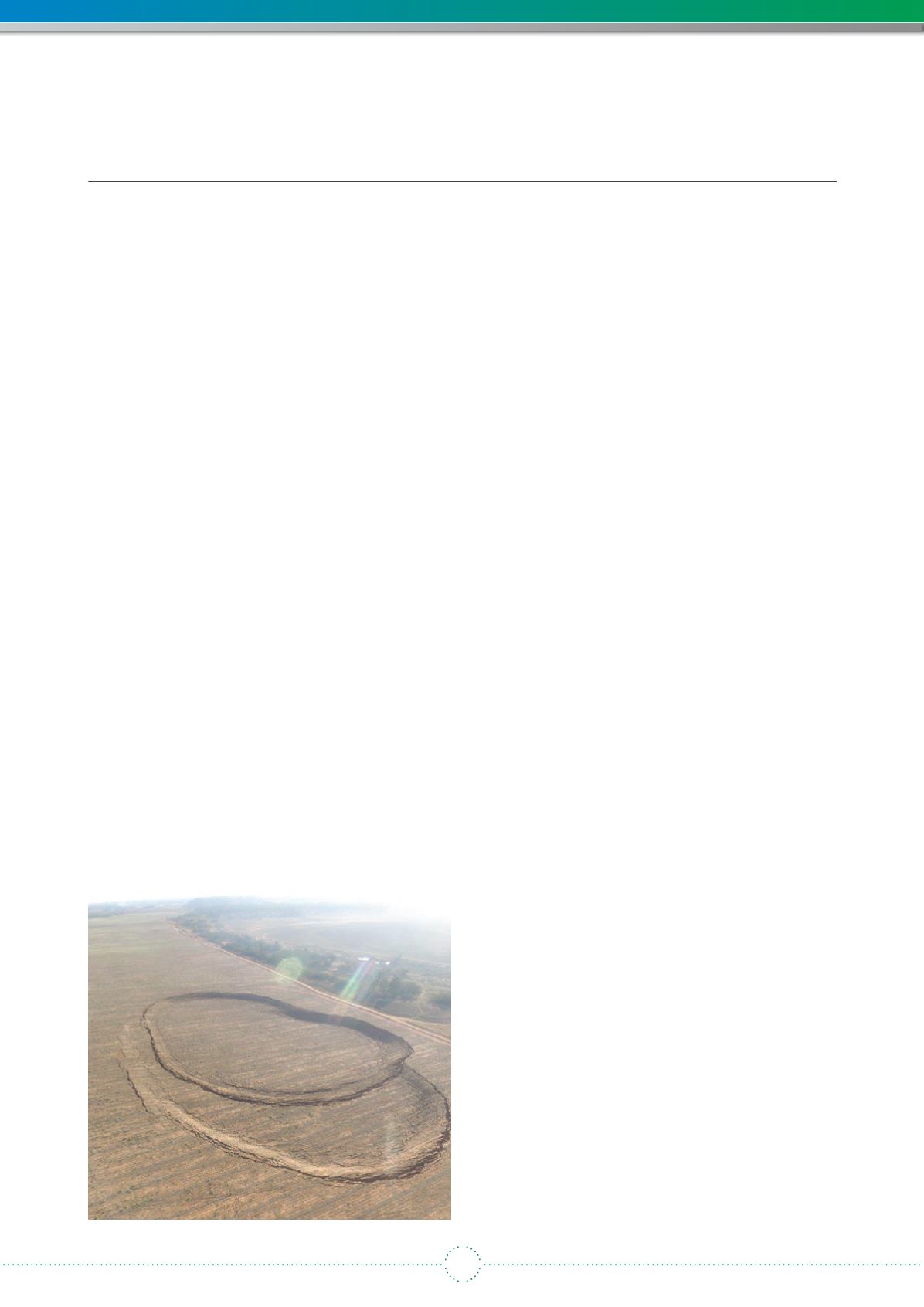
There have been many such collapses in the Witbank coalfield.
Below shows one such recent example.
The collapsed panels beneath this surface expression are
rectangular, but the outline of the surface collapse is curved!
The reason for this is that the tributary area theory for pillar
design ignores the strength of the bridging overburden.
Phenomena familiar to longwall and stooping mining, where
the overburden “hangs” up, and collapses in cycles, also known
as cyclic loading.
Modelling steps:
The Levkovitch-Reusch 2 (LR2) discontinuum
constitutive framework was applied in Abaqus to describe
the mechanical behaviour of the rockmass and structures.
The Appendix contains further details of the LR2 framework.
The numerical framework includes:
1. Three-dimensional (3D) geometry, with excavations
sequenced in a sufficient number of separate excavation
steps (called frames) to capture the necessary temporal
resolution for the project scope.
2. Strain-softening dilatant constitutive model for the rock
mass and structures with a generalised Hoek-Brown yield
criterion. Different material properties are assigned to each
geotechnical domain.
3. Discontinuum formulation using cohesive finite elements
to model discrete structures. Cohesive elements are free to
dislocate, dilate and degrade and can realistically capture
the behaviour of thin structures. The complete interpreted
structural model at the required resolution can be included,
and where appropriate, can be supplemented with a
discrete fracture network (DFN) to improve the structural
resolution.
4. General contact formulation to model frictional contact
between free surfaces in the model. Contact is essentially
the definition of parts interacting with one another
and/or itself.This allows capturing frictional contact between
bedding planes and discontinuities in the rock mass and
also allows for the consideration of contact between new
surfaces due to coal extraction and severe deformation in
the coal seam layer.
5. Structures less persistent than those modelled explicitly can
be represented by“smearing”the effects of structures within
the continuum regions of the modelled rock mass.
6. Hydromechanical coupling, where necessary, to capture
the effects of pore water pressure on the rock mass yield
surface.
SIMULATION OF REGIONAL COLLAPSES
IN BORD & PILLAR WORKINGS
D. MINNEY


