17
SOIL REHABILITATION: CAN DUNG BEETLES
IMPROVE POST-MINING LAND-USE OPTIONS?
J. DABROWSKI, J. BADENHORST, G. VENTER, C. SCHOLTZ & W. TRUTER
Purpose of the study
The activities of ants, termites, dung beetles and earthworms
are all known to positively impact on a range of soil health
parameters. However, to our knowledge, none of these groups
have deliberately been applied as part of a land reclamation
strategy. The overall aim of this study is to determine whether
dung beetles could be used to improve post-mining land-use
options through their dung-burial activities. This has been
achieved through a series of experimental and field-scale
studies to determine whether dung beetles can maintain their
activities along with established ecosystem services in the
soils typically found on rehabilitated mines. This information
forms the basis of recommendations for the use of dung
beetles as a complementary method within the current mix of
rehabilitation methods.
Important findings from this study
1. Dung beetles can be attracted back to rehabilitated mines
Dung-baited pitfall traps were used to determine dung
beetle diversity and abundance at five rehabilitated mine
sites. A total of nine collections were made over a period
of three years during summer months. Collectively, 13 921
individual beetles were collected from the five mine
sites compared to 58 546 from the three reference sites.
On average there were 54 species at mine sites compared
to 76 species at the reference sites. Although there is an
obvious decline in species diversity and abundance at the
mine sites, there appears to be sufficient source populations
in the vicinity of the mines to re-populate these sites over
time with the provision of dung.
Dung beetles sorted for identification from mine sites
(left) and active on rehabilitated mine sites (right)
2. Dung beetles can be bred for mass release on mines
Dung beetles have been successfullymass-reared for release
in various countries. While attempts have been made to
breed large numbers of beetles for this project, with the
main focus on three species: Digitonthophagus gazella,
Onitis alexis and Euoniticellus intermedius, these never
yielded very high numbers. In 2016 a visit to a mass-rearing
facility in New Zealand revealed that in order to breed high
numbers of dung beetles for release, a custom-built facility
with at least two full time staff members is required.
The facilities are not expensive and the work is not highly
specialised but optimising the beetle numbers requires
daily, dedicated attention for the full duration of the
breeding season (summer) and less intensive maintenance
work during winter. The three species identified for breeding
naturally occur at the mine sites and therefore remain good
prospects for future breeding programmes.
Dung beetle mass breeding facility in New Zealand
showing containers full of dung beetle brood balls
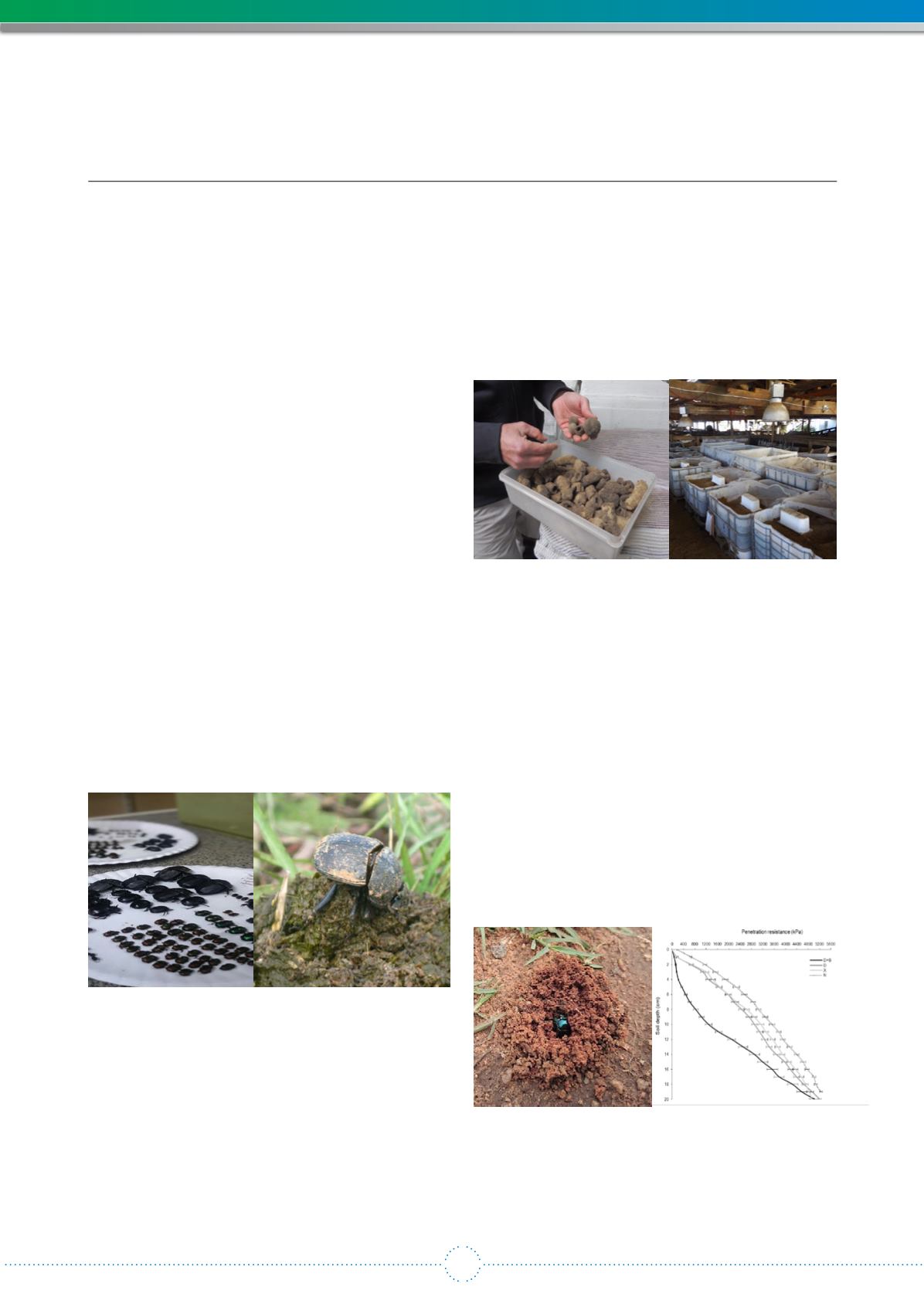
3. Dung beetles can tunnel into highly compacted soils
Three species of dung beetles applied in field trials on a
rehabilitated mine site could tunnel into compacted soils
with an average penetration resistance of 3 193kPa and
maximum measurement of 5 000kPa. Their tunnel depths
were slightly shallower than depths reported in other
literature. Evidence of successful breeding with brood balls
containing eggs and larvae produced by all three species
was also present. The three species investigated occur
naturally at all of the mine sites surveyed in this project,
which shows that compacted soils would not prevent
tunnelling by a range of dung beetle species naturally
present at mine sites. These results are supported by field
trial applications which included a wide range of species
applied in enclosures to prevent their escape. They have
been observed to immediately feed on the dung and have
not been found at the soil surface at a later stage, thus
implying they had managed to tunnel into the soil.
Naturally occurring Gymnopleurus pumilus burrowing
into highly compacted soil (left) and a graph showing
how applied dung beetles (black line) have significantly
reduced soil compaction (penetration resistance) in field
studies on rehabilitated mines at depths of up to 20cm
(right)


